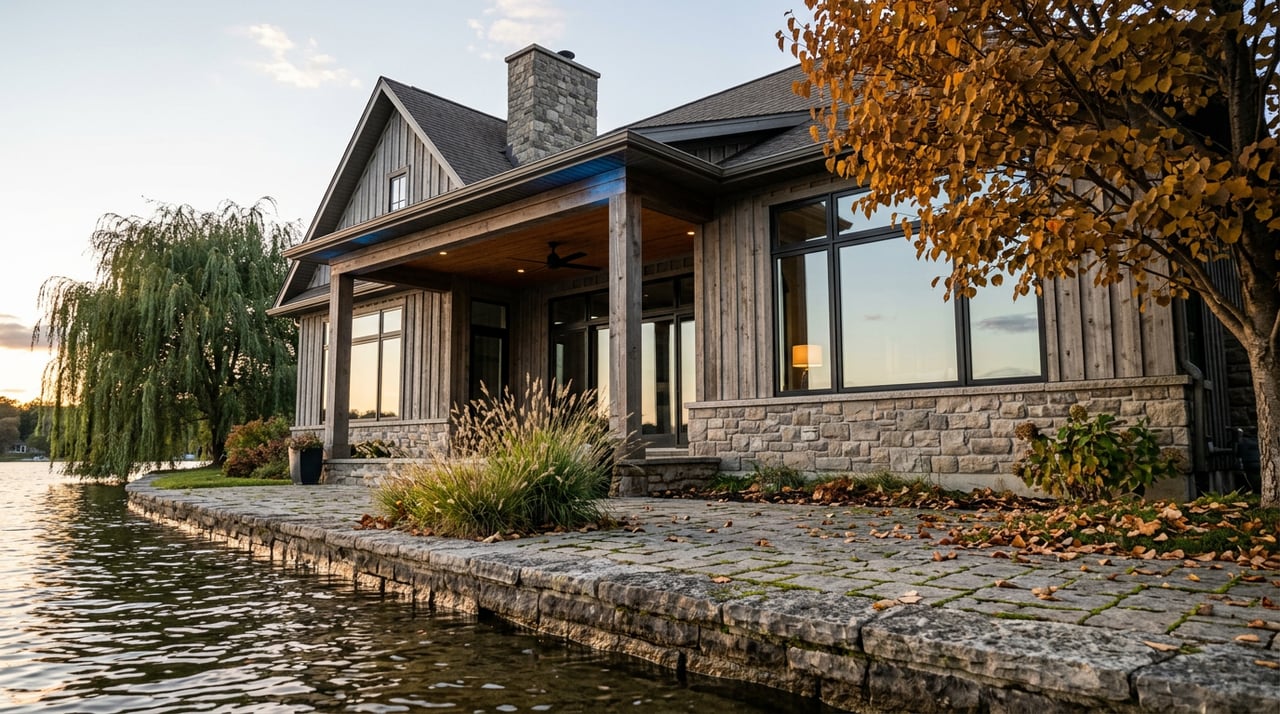
For the better part of a decade, the stretch of Lakeshore Drive across from Kershaw Park sat behind a construction fence with almost nothing happening behind it. Anyone who has walked that corridor between downtown Canandaigua and the north shore has probably wondered the same thing: when is the rest of Pinnacle North finally going to get built?
That question has an answer now, and it is not the one most people were expecting. Ontario County broke ground in August 2026 on a $24 million culinary arts center for that site, not more apartments or townhomes. The land that sat quiet for years while a stalled housing phase waited for a developer to sort itself out is becoming a college building and a public park instead. For anyone shopping the Canandaigua waterfront market right now, that distinction matters more than it might first appear.
What Was Actually Approved Back in 2013
Pinnacle North did not start as a modest project. When the Canandaigua City Council approved the Planned Unit Development in 2013, the entitlement covered roughly 34 acres between Booth Street and Muar Street, with a total buildout of about 450 residential units and somewhere between 75,000 and 78,000 square feet of commercial space, spread across five phases. It was pitched as a full transformation of that end of the lakefront, and Phase 1 delivered on part of that promise. It opened in 2017 with roughly 135 residential units, a parking structure, retail space, and tenants like Young Lion Brewing and Abbott's Frozen Custard.
That still left well over 300 entitled units on the books, spread across four more phases that had not broken ground.
Why Phase 2 Never Happened
Construction on Phase 2 began, then stopped in the summer of 2018. Developer trouble at Morgan Management, the firm behind the project, put the second phase on indefinite hold. Reporting from the Finger Lakes Times a few years later described a site that had gone quiet: excavators sitting idle, promotional banners taken down, soil stockpiles graded over and seeded per state brownfield remediation requirements. The fencing came down. The rental trailer was removed. For years, the site existed in a kind of limbo, still zoned for hundreds of additional lakefront residences, but with no active construction and no clear timeline for when that might change.
That limbo is what just ended, and it ended in a direction nobody who was watching for "more Pinnacle North" was necessarily expecting.
The Land Went to a Culinary School and a Park, Not Housing
The Canandaigua Area Development Corporation, the nonprofit that has owned the remaining undeveloped Lakeshore Drive parcels since the project's early phases, donated a portion of that land for a new home for the Finger Lakes Community College culinary program, New York Kitchen, and a Cornell Cooperative Extension office. The resulting Culinary Arts Center of Excellence is a roughly 19,300-square-foot, single-story building going up on about 2.5 acres directly across from Kershaw Park and immediately west of Muar Street, funded by a mix of SUNY, the Sands Family Foundation, CADC, and Ontario County. Officials pointed to completion sometime in 2027.
Richard Sands, vice president of the Sands Family Foundation, one of the project's funders, described the goal as giving residents and visitors "increased access to the heart of the Finger Lakes for generations to come."
The remaining acreage on that block is not slated for housing either. City planning documents describe a companion public park on the adjacent land, with CADC leading design work once the culinary center's site plan is finalized. Between the two uses, the parcel that could have absorbed most of Pinnacle North's remaining 300-plus entitled units is now spoken for, permanently, by a college building and green space.
What Got Debated Before the Groundbreaking
The path to that groundbreaking was not entirely smooth. At a Canandaigua City Council Planning Committee meeting in May 2026, the formal item on the agenda was narrow: relocating a pedestrian easement and a sanitary sewer line to make room for the new building. The conversation that followed was not narrow at all. Council member Gwen VanLaeken pressed city staff repeatedly about how much of the broader lakefront redevelopment vision had already been decided behind the scenes, and whether residents had gotten a real chance to weigh in before the pieces started falling into place. The committee sent the easement request forward anyway, and the full council later moved the project along.
That meeting is worth knowing about if you are evaluating this market, because it confirms something important: the shift away from housing on this parcel was not a quiet bureaucratic footnote. It was a decision that generated real pushback from at least one elected official, and it went forward regardless.
Why This Changes How You Should Read the Current Listings
If you have already looked at what is on the market on Canandaigua Lake, you have seen the price. What the listing count does not tell you is why that number holds steady the way it does. As of mid-September 2026, a search filtered specifically to lakefront property in Canandaigua turns up around seven active listings, with a median list price near $444,000 and a typical time on market under three weeks. Widen the filter to waterfront generally, which pulls in a broader mix of lake, canal, and pond frontage, and the count rises to around 38 listings with a median closer to $459,000, still moving in under a month on average.
Those are small numbers for a market this desirable, and they are small on purpose now in a way they were not always. Downtown-adjacent, walk-to-Main-Street lakefront property was always going to be limited by geography. What changed in the last year is that the one obvious mechanism for adding meaningfully to that walkable supply, the remaining phases of Pinnacle North, has been formally redirected to institutional and public use. Barring some future redevelopment nobody has proposed, that inventory ceiling is not seasonal. It is structural.
That distinction should shape how you shop. If you are waiting for more walkable lakefront product to loosen up prices or widen your choices, the mechanism that might have delivered that supply just closed off. If you are comparing the walkable in-town stretch against shoreline farther from downtown, here is roughly how the tradeoff looks right now.
| Where | What's actually listing | What drives future supply | The tradeoff |
|---|---|---|---|
| Walk-to-downtown lakefront (Lakeshore Drive corridor and nearby) | A handful of resale listings at any given time, median near $444K, moving in under three weeks | The one parcel that could have added new units is now committed to a college building and a public park | You are bidding on existing stock only, this segment is not getting bigger |
| Outlying shoreline (South Bristol, Gorham, west shore coves) | Individual land parcels and homes list with some regularity; a recent look at nearby waterfront land showed roughly seven parcels averaging just under $390,000 | Vacant lakefront acreage still exists in these stretches, so new construction remains possible over time | Longer drive to Main Street restaurants and shops, but real room for new product to eventually get built |
Neither column is the "right" answer. A buyer chasing walkability and an established downtown scene is choosing a segment that will keep behaving the way it has for the last few years, because the supply story behind it just got locked in. A buyer more focused on acreage, privacy, or long-term building potential still has room to work with on other parts of the lake.
A Few Questions Worth Asking Before You Assume Anything
Does this mean there is no room left for lakefront development anywhere in Canandaigua? No. It specifically closes off the one large, contiguous, walkable parcel tied to Pinnacle North. Other stretches of shoreline outside the downtown core still include vacant land that could see new construction.
What happened to Pinnacle North's original housing plan? Phase 1 delivered roughly 135 of the 450 units originally entitled in 2013. The land once earmarked for phases 2 through 5 is now going to the culinary center and an adjacent public park instead of additional apartments or townhomes.
When does the new facility actually open? Ground broke in August 2026, with county and college officials pointing to completion sometime in 2027.
Will this affect anyone who already owns near that site? The approved easement changes reroute an existing sanitary sewer line around the new building and relocate the public pedestrian path connecting the city parking lot to Lakeshore Drive. Beyond construction activity in the immediate area, it does not change the residential zoning of existing homes nearby.
Where This Leaves You
The median price you saw on a portal search told you what things cost. It did not tell you that the mechanism most likely to add new inventory to Canandaigua's most walkable lakefront stretch has just been taken off the table for the foreseeable future. That is not a reason to panic into a purchase, and it is not a reason to assume prices will keep climbing without pause. It is a reason to treat the current, thin supply of walk-to-downtown lakefront homes as the baseline you are working with, rather than something you should expect to loosen up.
If you are weighing a walkable lakefront property against something farther down the shore, or trying to figure out what a specific parcel's history actually means for its long-term value, that is exactly the kind of question worth working through with someone who follows this market closely. Deanna & Steve Nissen can walk you through what is currently available on both ends of that tradeoff and help you figure out which one actually fits what you are trying to build a life around. Get in touch when you are ready to look.